

What if the thing that is making your pain worse—or your frustration worse, or your practice harder—is not your body at all?
What happens when we prioritize thoughts and words over all other forms of evidence – evidence from the body, evidence from behaviors, and evidence from the internal and interpersonal systems that tell us, “Something isn’t quite right here. Things are not lining up somehow.”
The Body Has Something to Say
A fairly young yoga practitioner – in his late 20s – came to talk to me after class the other day. It started out about a question regarding the ankles in Fixed Form pose but quickly – and unsurprisingly – moved to the bigger picture philosophies behind the yoga practice.
He told me that he had maintained a Hatha Yoga practice some years ago, and now that he is returning to practice, he is finding that his body simply cannot do what it used to do. He was able to articulate that he felt mad—frustrated that he had lost a physical proficiency he once had.
I understood exactly what he meant. And I know that a majority of yoga practitioners go through something similar at various points in their practice.
So I started to share about one of the many ways that I have gone through this very process. (And trust me, there have been many!)
A Little Theory First
When the mind is comparing—whether you are measuring yourself against someone else, against your past self, or against some idealized expectation of what you should be able to do—your mind is not in the present moment with your body. It is living in an abstraction. And abstractions, by their nature, are disconnected from what is actually happening right now.
This does not mean that we should banish all abstractions, nor that we should stop making meaning and sense out of our embodied experiences and emotions. That is a most dangerous path indeed.
In fact, we must get more in tune with our experiences and emotions, and allow our wisdom and abstractions to unfold from their bodily roots.
During the course of practice however, we make demands on ourselves to do something very specific: to direct the mind out of those abstractions and into the present, embodied moment, with curiosity rather than expectation.
Easier said than done, I know. So I told him the story of what happened when my back was broken in 2004.
The limit of what I could do
When my lumbar spine was fractured, I still showed up to practice. Nearly every day. I remember in great detail, the feeling of attempting a forward bend. (I.e. the motion where you bring your forehead towards your knee or knees; also called spinal flexion.)
I could tuck my chin to my chest, maybe halfway. Sometimes, not even that much. And even with only that tiny movement, I quickly reached the limit of what my body could do—the exact point where moving any further started to induce intense pain.
Now, in the previous months, I was pretty easily able to get my forehead all the way to my knee. And here I was, just barely able to bring my chin down an inch.
I could have spent that entire class being upset. Dwelling on: I can’t do this. I used to be able to do this. When am I going to be able to do this again? When is this going to stop hurting?
But I discovered something quickly and unmistakably. When I tried to tuck my chin and hit that limit, my mental state had a direct effect on my physical experience. If I focused on my expectations, my disappointment, or my comparison to the past, the pain actually was worse.
But if I focused entirely on the exact sensation in the present moment—how much can I tuck my chin right now, before the pain starts?— and on the smooth pattern of every single breath in and out of my nose, I experienced significantly less pain. I was able to relax in a way, to tune into what was happening.
So that I could hear the unmistakable signals coming from within.
I learned pretty quickly that the body was telling me the truth. My abstract mind was the one making things worse.
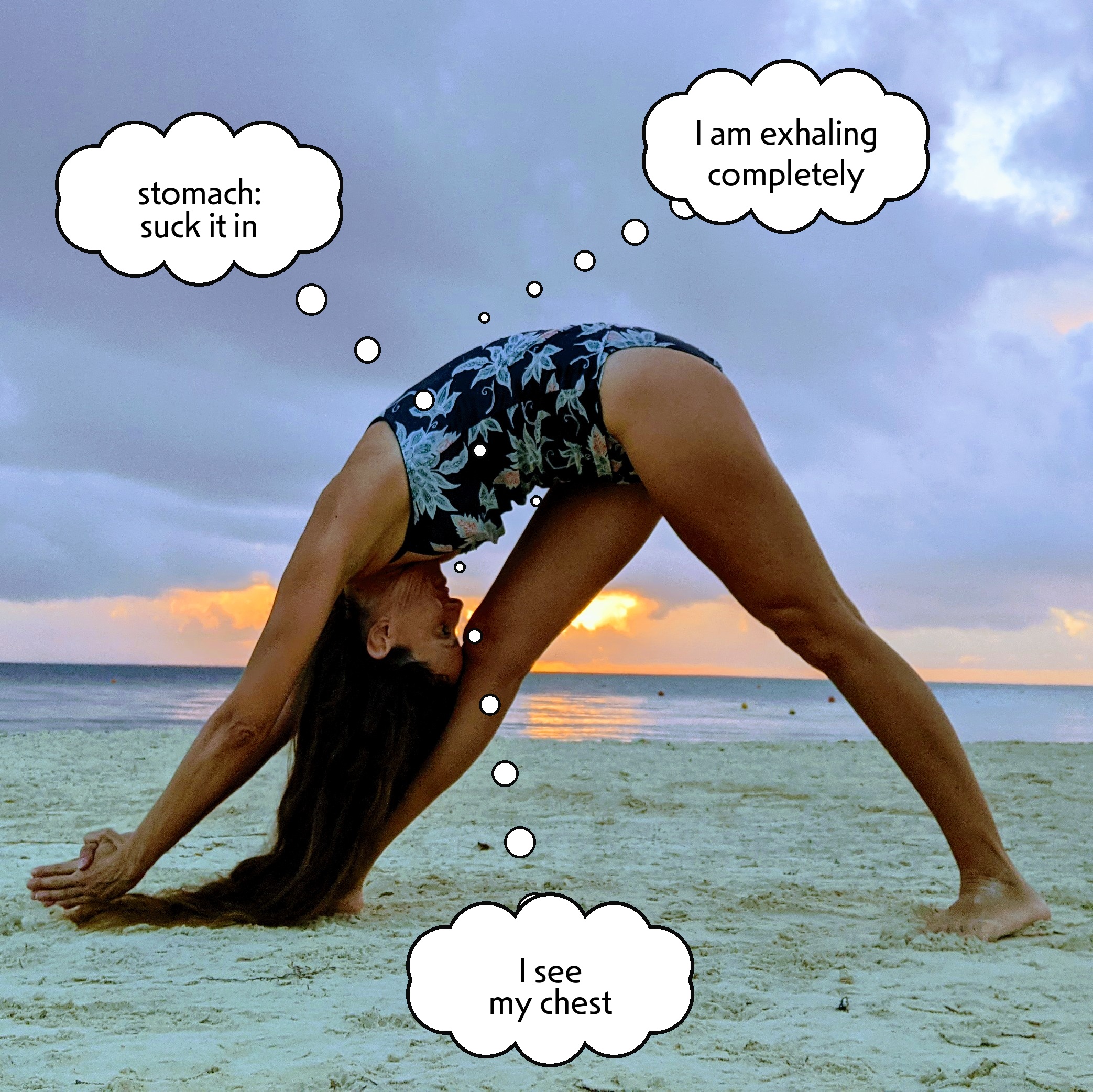
The blessings of a broken back
I acknowledged to this student that, in a strange way, the injury made the mental discipline aspect of the class much easier for me. The pain signal was undeniable. It forced me to stop, to concentrate, to be present—because the alternative was pain that I simply could not ignore.
For most people, in the absence of significant injury—which I certainly do not wish on anyone—it is much harder to rein in the mind through willpower alone. Without that urgent physical signal, the mind’s abstractions and deceptions can go unchecked for a long time.
This is why I refer to it as the blessings of a broken back.
Pain, as brutal as it is, can be a remarkable teacher. The wisdom of the body, if we are truly open to it, will guide us to the appropriate words, descriptions, and concepts.
So back to the question I started with. What was making things harder—for me in that hot room with a fractured spine, and for my student standing there frustrated after class?
It wasn’t the body. The body was just telling the truth. It was the mind—comparing, projecting, compartmentalizing, living anywhere but here—that was the source of the suffering.
The body does not lie. It cannot. It only ever exists right now. And yet it is also full of wisdom from the past.
This practice, at its core, is a training in learning to trust the body—and to stop blindly trusting the abstract and categories of the mind, the way our culture has so relentlessly trained us to do.
The mind’s place and its purpose are not nothing. Cognitive processes, abstractions, labels, past, and future are absolutely important to our lives. But they must be constantly informed by the non-verbal, the embodied, the uncomfortable, the real.
Exactly as our teachers have taught us, over all these hours, weeks, months, and decades. Thank you especially to Bikram, Rajashree, and Emmy.