
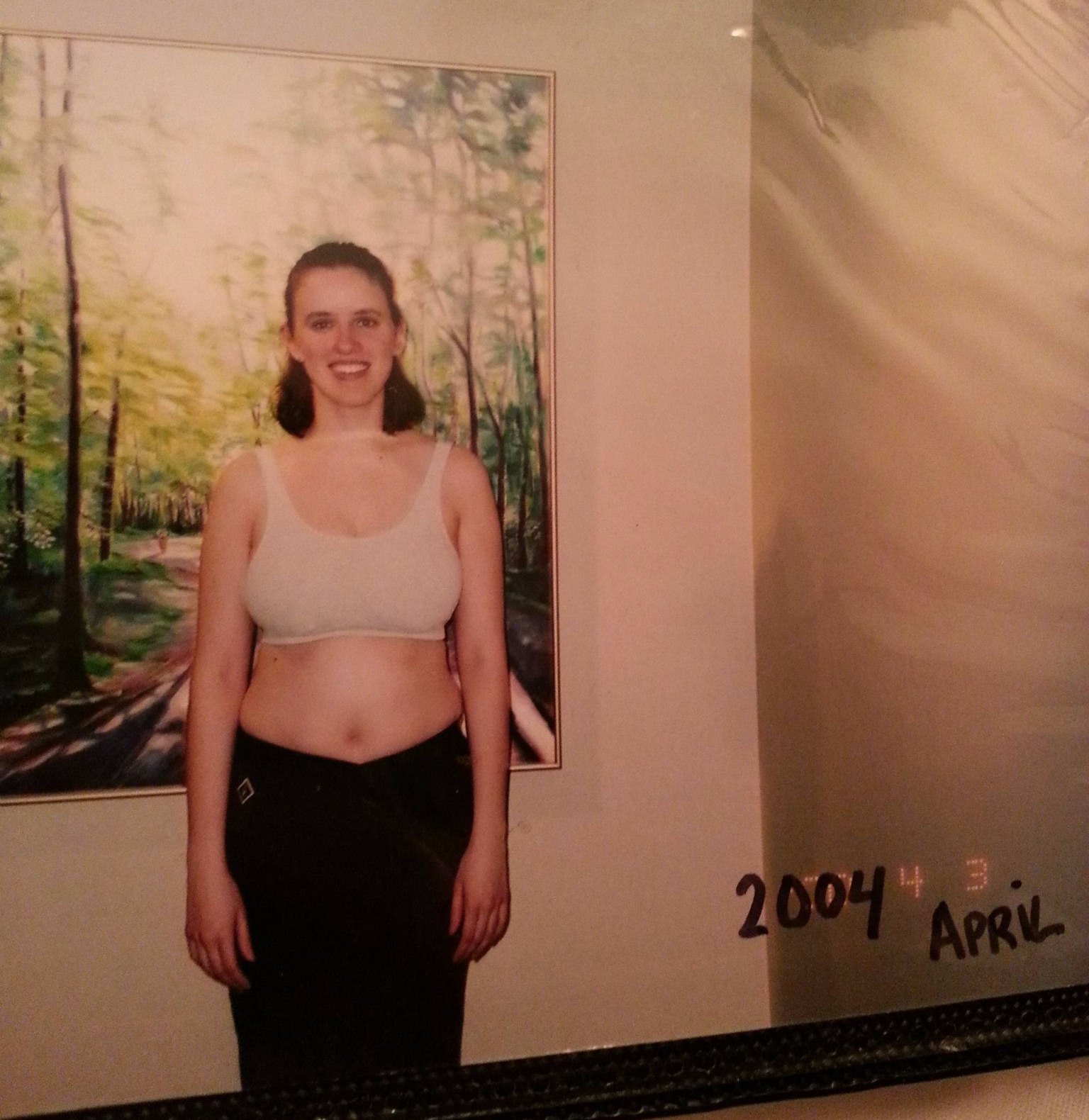
I have learned a dozen lessons and received a thousand blessings from my back injury on March 17, 2004.
Today is the twenty-second anniversary of that morning.
If you missed the first two parts of this story, you can read Part 1 and Part 2 first. But the short version is this: I slipped on black ice on my way to a 6:00 am Bikram Yoga class in Ann Arbor, Michigan. After a full day in the ER — x-rays, morphine, a CT scan, and one nurse who cared enough to stay on the case past her shift change — I was told that the transverse processes on L1 and L2 were completely fractured. Separated from the body of the vertebrae.
As I wrote in Part 2: everything is connected in there. It is just that we usually do not feel it.
The Prescription: Narcotics and Immobility
The medical recommendation was straightforward, at least from their perspective: a month’s worth of narcotic painkillers, absolutely no yoga or other exercise for six weeks, and the mandatory wearing of a corset-type torso brace for a full six weeks.
I tried to follow their instructions. I really did.
For about 48 hours, I wore the brace, took the medication, and stayed as still as possible.
But instead of feeling better, I felt worse and worse. The physical stiffness was profound, but the side effects of the narcotics were even more debilitating. I became constipated, deeply depressed, and more stiff. My mind, which had found such clarity and peace through my near-daily Bikram Yoga practice, was clouding over again.
I knew I could not continue down this path.
Going Against the Grain
So, despite protests from everyone around me, I decided to go back to yoga.
I couldn’t drive a car yet, but my sister reluctantly offered her support. She drove me down Washtenaw Avenue to Bikram Yoga Ann Arbor and watched, disapprovingly, as I went against the advice I had been given. I understood her concern. But I also understood something she couldn’t quite see yet: that the yoga was giving me something the prescription could not.
Stepping back into the hot room, I became a student of my own anatomy in a way I had never been before. I discovered quickly that I was completely unable to forward bend any part of my spine — even my neck — without intense, sharp pain at the muscular area surrounding the fractures.
But then, a revelation.
A small amount of backward bending — both local extension and complete spine extension — not only didn’t hurt, but it brought immense, profound relief.
Interesting, I thought.
(At this point, I was already set to attend Bikram Yoga Teacher Training in Los Angeles, beginning at the end of June 2004. I had applied, been accepted, and paid my deposit. In those first days and weeks after the break, the worry that I wouldn’t be able to go was heavy on my heart. I desperately wanted to find a way to feel better before training. Yet I knew I couldn’t force anything.)
Healing Through Attention and the Method
The Bikram Yoga method is often misunderstood from the outside as purely physical, or even forceful. But from the inside, especially when you are injured, it becomes something else entirely: a practice of profound stillness and microscopic attention.
In those weeks of late March 2004, I went to class almost every day — four or five times a week. My practice looked vastly different from the “ideal” expressions of the postures. I moved with extreme caution. I listened intently to the dialogue, but I listened to my body’s boundaries even more closely. I moved even more slowly. I felt every bit of every breathe. I found stillness in the heat. I allowed the backward bends to gently squeeze and heal the area, while respecting the absolute limitation on forward bending.
*(Years later, in 2017, I suffered a soft tissue injury that caused a nearly identical mobility limitation — and I decided it would be worth capturing on video what that post-fracture practice had looked like back in 2004. You can see it for yourself in these two videos from our YouTube channel: Rehabilitative Super Slow Standing Series — Healing from Acute Low Back Injury and Floor Series — Slow Rehabilitative Yoga — Healing from Acute Back Pain. The story behind those videos is exactly this one.)*
During those weeks immediately post-fracture, there was no way I could get any other kind of exercise. It hurt to sneeze. I couldn’t tie my shoes. I couldn’t even roll over in bed without pain. But I was able to go to the heated classroom — to concentrate, to move just a little bit, to move what I could and to not move what I couldn’t. And at the same time, I was getting this tremendous cardiovascular, pulmonary, circulatory, lymphatic, and immune system benefit that is pretty hard to get when you really can’t move very much.
This is something I have thought about a great deal in the years since, and it is central to what I now understand about this yoga as medicine. In our book *Hope for Autoimmune Disease*, fifteen people told us their stories of living better with Bikram Yoga. The themes that emerged — reduced inflammation, improved circulation, a quieting of the body’s dysregulated systems — were not surprises to me. I had felt those mechanisms at work in my own spine, in those early weeks of 2004, when I had almost nothing to work with but breath and heat and the willingness to show up.
21 Days Later
Exactly 21 days after the fracture, the pain was completely gone.
My body felt good enough for me to practice almost normally. At that point, I had about three months before Teacher Training started.
The Lessons of Teacher Training
When I arrived at Teacher Training in Los Angeles, I was surrounded by a diverse group of people. Some were there with a very strong mindset of accomplishment, of intense athleticism. It was all very beautiful and inspiring. There were also some people there who were vocal about how the yoga had helped heal injuries, mental health struggles, and eating disorders. I think ultimately, everybody there had some sort of significant healing story behind why they were there.
For me, the healing story was particularly intense, extreme, and recent. Just months before, I had experienced in my own spine — in the most visceral, undeniable way — the healing potential and almost the healing purpose of this practice. I arrived at training already knowing, deep in my body, that the class could be practiced in a slow, scaled-back, healing-oriented way. I had lived proof of what this practice could do. And that knowledge was very fresh.
A Philosophy for Teaching
As soon as I started teaching after training, I carried this experience with me. I always had in my mind that the yoga sequence, the heat, the concentration, and all of the elements in a Bikram yoga class made it this space where you could come in, in any physical state, do a little bit, and get a lot of benefit.
I have carried this experience with me through every single class I have taught in the more than twenty years since. So that when a person walks in telling me something hurts, or “I have this injury,” I am not worried at all. I know that we can modify the depth of postures. I am there to support them in figuring out how to move in ways that don’t worsen the injury or the surgery or whatever has happened — but also to help them find ways to do as much of the posture as possible.
That icy morning in 2004 gave me a broken back. But it also gave me the deepest possible trust in this yoga as medicine. And that is a blessing I get to share with all of you, every single day in the hot room.
. . . . . . . . . . . .
*To be continued…*